
This post is also available in:


Vova Design’s research unfolds within a threshold territory, a conceptual space in which art and design cease to be separate fields and become interdependent practices. Here, the project does not respond to a predetermined function, but opens onto a broader reflection on the meaning of matter, the temporality of gesture, and the possibility of transformation.
Each work originates from an act of inquiry: what remains when function is removed? What new identity can emerge from what has been consumed, discarded, or rendered invisible?
Vova Design’s work is grounded in an idea of process rather than outcome. Form is never immediate or definitive, but constructed through successive stratifications, minimal deviations, and controlled repetitions. Matter always retains the memory of its becoming: the gesture is not concealed, the surface is not pacified. On the contrary, imperfection becomes language, a tangible sign of time acting and leaving traces.
The works of Vova Design do not seek formal perfection, but a deep coherence between matter, gesture, and meaning. Every choice is measured, every deviation intentional.
Color and form assume a conceptual value even before a visual one. Blue, white, and red do not function as closed symbolic codes, but as perceptual states, fields of experience. Color envelops, suspends, compresses; at times it withdraws, leaving space for silence and waiting. In the same way, form does not represent, but suggests: organisms in growth, structures under tension, surfaces traversed by internal forces.
Vova Design’s research thus situates itself within a deeply contemporary dimension, in which the work does not offer answers, but conditions for listening. Each piece invites the viewer to slow their gaze, to dwell within the process, and to recognize transformation not as a loss, but as a possibility. Art and design intertwine in an essential and rigorous language, capable of generating meaning through matter and time.
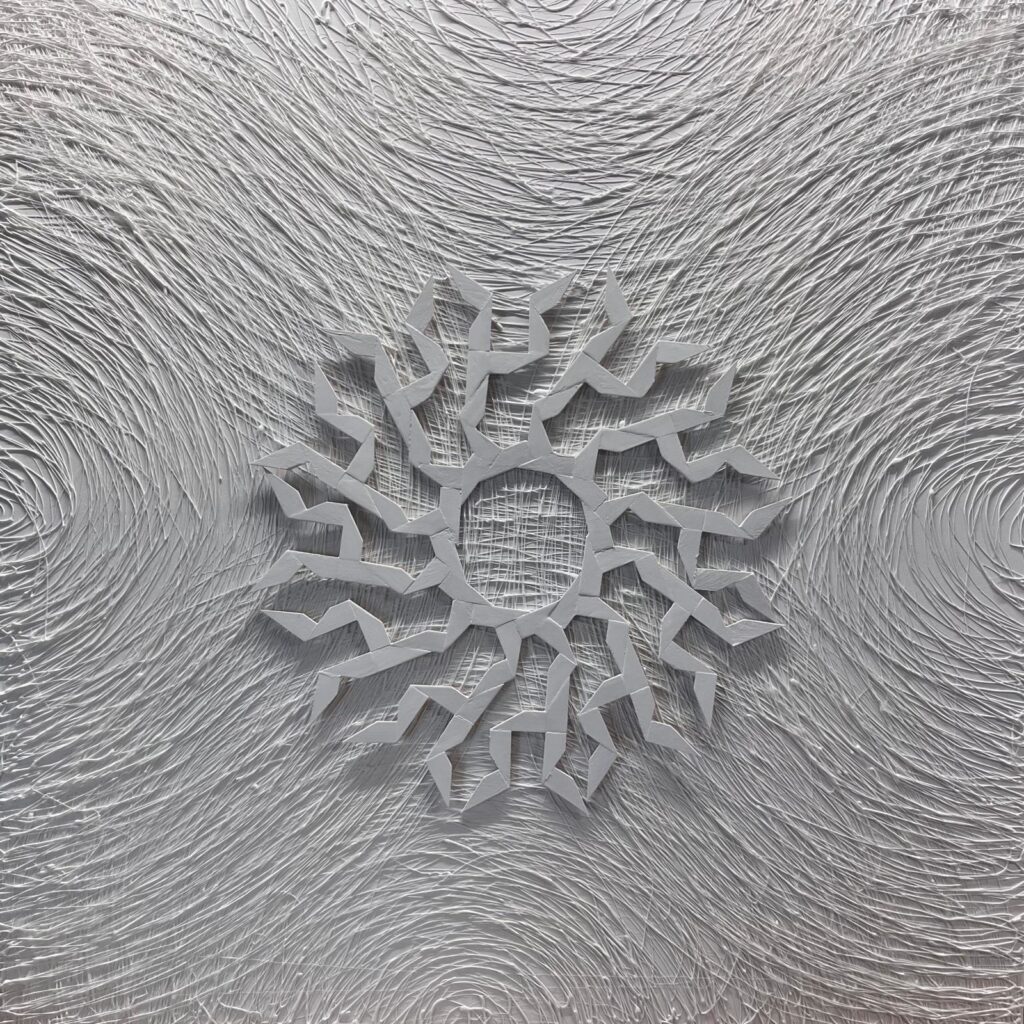
In White Air Coral 2.0, form expands from a central void that is not filled, but declared. White cancels color to allow the structure to emerge, making the process visible rather than the result. The irregular branching evokes an organic growth, fragile yet resilient, in which matter preserves the memory of its fractures. The work does not represent nature; it adopts its method, based on adaptation, expansion, and continuous transformation.
With Blue K Line of Choice, color becomes the absolute protagonist. The saturated blue transforms the surface into a mental, immersive space, devoid of visual hierarchies. Repetition suggests order, yet each incision introduces a deviation, a silent choice. Decision is not an isolated event, but a permanent condition: a multiplicity of paths that coexist without converging toward a single direction.
In Red Spike, matter is charged with a more direct and physical tension. Red is not a symbol, but compressed energy, impulse, pressure. The incised surfaces converge and repel one another, generating a visual dynamic that evokes heartbeat, urgency, and vital force. Here, transformation is not meditative, but necessary—an act that emerges from the conflict between density and movement. Red Spike does not seek balance; it puts it into crisis.
Through these works, a coherent poetics emerges, grounded in repetition, variation, and the memory of gesture. The module is never serial in a mechanical sense, but traversed by imperfections that make it alive. The gesture remains visible, controlled, never decorative. Color, when present, does not describe but envelops; when it withdraws, it leaves space for silence and possibility.
The works of Vova Design do not call for a single, fixed reading, but for a slow and conscious traversal. They are relational spaces in which matter, form, and color become tools for reflecting on change, choice, and the capacity for regeneration. Each work is not a point of arrival, but a stage within an open process, where art and design intertwine to give shape to new possibilities of meaning.
Elisa Larese Moro Art Historian